
Meet Olena, an amazing teacher from Lviv, Ukraine who is passionate about language learning and floral arrangements. Olena’s class is part of the Ukraine Youth Action Network (UYAN) which just recently shared their final group project. In this interview, Olena shares what led her to teaching, what inspires her, and how we can build empathy and understanding through initiatives like UYAN.
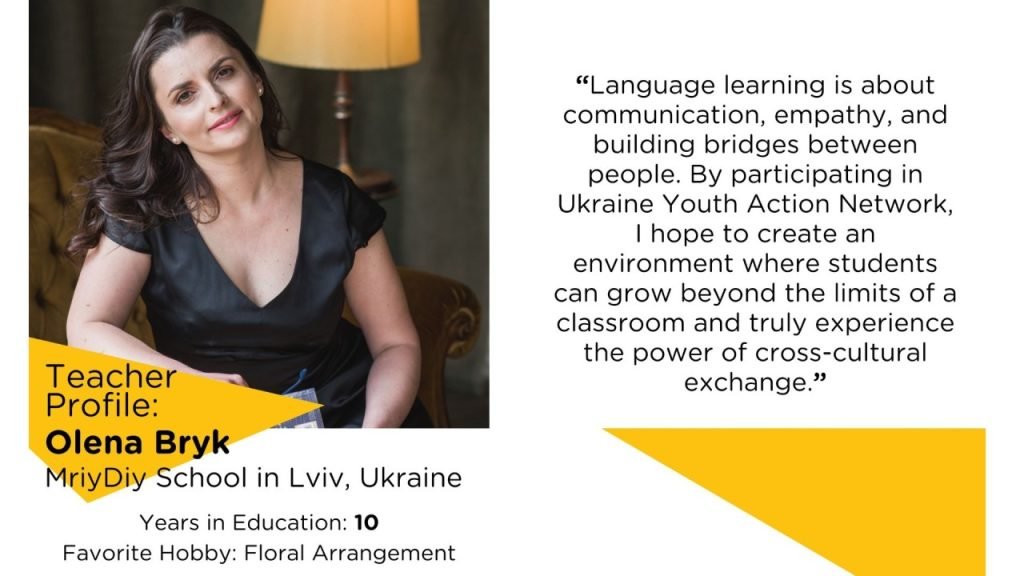
Olena, a teacher from Lviv, Ukraine, brings warmth, creativity, and deep reflection to the Ukraine Youth Action Network (UYAN), where she leads students in exploring identity, empathy, and intercultural understanding
Q: When and how did you decide to become a teacher?
A: My journey began in middle school in the 1990s. I was fortunate to have an extraordinary English teacher whose approach stood out from the rest. Unlike traditional methods that often felt rigid and mechanical, her teaching was immersive, inspiring, and full of life. She didn’t just teach English—she unlocked an entire world of language, culture, and expression.
For the first time, learning felt like magic, and I was captivated by the idea that a teacher could do more than just transfer knowledge—they could ignite curiosity, transform perspectives, and open doors to endless possibilities. That experience left a lasting mark on me, and I knew then that I wanted to do the same for others. Teaching, for me, is not just about lessons and textbooks; it’s about sparking that same sense of wonder and discovery in my students.
Q: What is the best part of your job?
A: Witnessing the moment when a student stops seeing English as just a subject to study and starts embracing it as a natural extension of their personality. It’s that incredible shift when they no longer translate in their heads but think, feel, and express themselves freely in the language.
It’s more than just mastering grammar or vocabulary—it’s about confidence, identity, and the ability to connect with the world in a new way. Seeing that transformation, when English becomes a tool for self-expression rather than just a foreign language, is truly rewarding. It means they’re not just learning—they’re growing, evolving, and expanding their horizons.
Q: Who or what inspires you the most in life?
A: Inspiration comes to me in two very different but equally important ways. On a personal level, my two French bulldogs bring me endless joy. Their playful nature, unwavering loyalty, and ability to find happiness in the simplest moments remind me to appreciate life’s small but meaningful joys.
On a professional level, what truly drives me is the opportunity to contribute to meaningful changes in Ukrainian secondary education. I believe that education has the power to shape not only individuals but entire generations. The prospect of improving teaching methods, fostering a love for learning, and helping students unlock their full potential keeps me motivated every day. Making a difference, no matter how small, is what fuels my passion for teaching.
Q: What inspired you to take part in the virtual exchange program?
A: My decision to take part in the virtual exchange program was driven by a genuine interest in fostering collaboration between the USA and Ukraine. I believe that meaningful connections between different cultures enrich education in profound ways.
This program offers a unique opportunity for students to expand their cultural horizons, see the world from new perspectives, and develop a deeper understanding of global interconnectedness. Language learning is about communication, empathy, and building bridges between people. By participating, I hope to create an environment where students can grow beyond the limits of a classroom and truly experience the power of cross-cultural exchange.
Q: What sort of activities do you do with your students as part of this program?
A: As part of this program, my students and I engage in a variety of activities designed to enhance self-expression, collaboration, and cross-cultural understanding. One of our key focuses is self-presentation, where students create photo and video blogs to introduce themselves in a more personal and creative way.
We also produce a video about our school community, offering a glimpse into our daily lives and learning experiences. This exchange sparks curiosity and helps students on both sides of the ocean see how their peers study, interact, and navigate school life.
Beyond that, the program teaches invaluable skills in flexibility and tolerance. When selecting project topics, students learn to respect different perspectives and compromise, which fosters open-mindedness. Teamwork is at the heart of our activities—we brainstorm ideas, assign roles, and bring our creative visions to life together.
Finally, one of the most exciting and rewarding moments for my students is presenting their projects in front of the entire UYAN community. This experience builds confidence, hones public speaking skills, and gives them a sense of accomplishment, knowing they’ve contributed to a meaningful cultural exchange.
Q: In what ways can this program contribute to building understanding and empathy among students from different backgrounds?
A: This program plays a crucial role in building understanding and empathy among students from different backgrounds by starting with something simple—finding common ground. In the beginning, we focus on shared interests, hobbies, and everyday experiences. Recognizing these similarities helps break down barriers and fosters a sense of connection.
As the program progresses, students begin to appreciate not only what unites them but also what makes each of them unique. They highlight their strengths, exchange perspectives, and collaborate on meaningful projects that reflect their diverse viewpoints. These projects aren’t just exercises in teamwork—they are powerful bridges between cultures, designed to capture the interests of all participants and leave a lasting impact on both communities.
Q: How are your students thinking about their future?
A: Right now, my students are facing an uncertain future, shaped by the reality of living through war for the past three years. This uncertainty naturally brings anxiety, as they navigate their dreams and ambitions in a world that feels unpredictable.
One of my greatest concerns is that many of my students are considering pursuing higher education abroad. While I fully support their desire to seek the best opportunities, it’s bittersweet to see bright, talented young people feeling the need to leave their home country. However, I also believe that they are not just students of Ukraine—they are citizens of the world.
I am confident that wherever they go, they will gain invaluable knowledge, skills, and perspectives. And my greatest hope is that one day, they will bring that experience back home, using it to rebuild, innovate, and contribute to a stronger, more prosperous Ukraine. They carry both resilience and ambition, and I have no doubt that their journeys, no matter where they lead, will ultimately shape a better future for all of us.
Q: Can you share an instance where you learned something unexpected from one of the students in the program?
A: One of the most unexpected lessons I learned from my students in this program came during our very first activity—photo blogging. I assumed this would be a simple and engaging way for students to introduce themselves, but to my surprise, it turned out to be one of the most challenging tasks for participants on both sides.
I hadn’t fully realized how much thought and effort goes into self-presentation. Crafting a short yet meaningful narrative about oneself—choosing the right words, images, and details—requires deep reflection. It’s not just about stating facts; it’s about telling a story that captures identity, values, and aspirations in just a few sentences.
This experience made me appreciate the complexity of self-expression. It was a powerful reminder that even the simplest tasks can hold unexpected depth, pushing us to think more critically about how we define and share our identities.